
February 10, 2026 Posted by AHW Endowment
Brain tumors are rare, but their impact on individuals, families, and communities is profound. With a five-year relative survival rate of about 35%, brain cancer remains one of the most complex and difficult cancers to treat. For Wisconsin families navigating a diagnosis, the science alone can feel overwhelming, layered with uncertainty about what comes next and what the future may hold.
 In a recent Coffee Conversations With Scientists episode, Jennifer Connelly, MD, a Neuro-Oncologist with Froedtert’s Cancer Center and professor at the Medical College of Wisconsin (MCW), helped break down what researchers know about brain tumors, why treatment is uniquely challenging, and how research and community support are shaping progress. Her perspective underscores both the seriousness of the disease and the importance of continued investment in research and care.
Why Brain Tumors Are So Difficult to Treat
Brain tumors generally fall into two broad categories. Primary brain tumors originate in the brain itself, while metastatic brain tumors begin elsewhere in the body, such as the lung or breast, and spread to the brain. Glioblastoma is the most common primary malignant brain tumor and is known for its aggressive nature. These tumors often appear as a single mass, while metastatic tumors are more likely to present as multiple lesions scattered throughout the brain.
Treating brain tumors presents challenges unlike those seen with many other cancers. Surgery is often limited by tumor location, since removing tissue from critical areas of the brain can permanently affect a person’s ability to speak, move, or think. Even when surgery is possible, it is rarely curative on its own.
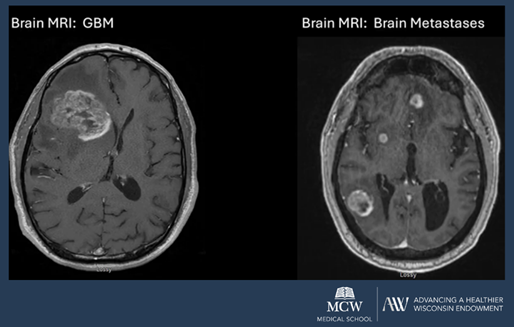
During the episode, Dr. Connelly shared MRI images illustrating the difference between glioblastomas and brain metastases.
Another major obstacle is the blood-brain barrier. This natural protective system shields the brain from toxins and infections encountered in everyday life. At the same time, it prevents many medications from reaching tumor cells in sufficient concentrations. While this barrier is essential for brain health, it significantly complicates the development and delivery of effective treatments.
Imaging tools such as MRI scans are critical for diagnosis and monitoring, but they cannot show the full extent of the disease. Glioblastoma cells can spread microscopically beyond what imaging detects, weaving through healthy brain tissue. As a result, what appears contained on a scan may still be more widespread at the cellular level.
What Diagnosis and Treatment Often Look Like
People with brain tumors may experience a wide range of symptoms. Some present with seizures, others with persistent headaches, and others with neurological changes such as weakness or numbness on one side of the body, vision problems, speech difficulties, or balance issues. These symptoms often develop gradually and worsen over time, which can delay diagnosis.
Despite extensive research, the causes of most brain cancers remain unknown. Environmental factors, including cell phone use, have been studied extensively, with no proven links identified. Brain tumors also rarely run in families, with fewer than 5% of glioblastomas considered hereditary.
For most patients, treatment begins with surgery to confirm the diagnosis and relieve symptoms. For glioblastoma, care typically continues with a combination of radiation therapy and chemotherapy. Radiation treatment usually spans six weeks, while chemotherapy is often taken orally at home. Dr. Connelly likens this phase of care to a marathon, requiring endurance, careful monitoring, and strong support systems.
Statistics about brain cancer can be difficult to interpret, particularly when they rely on outdated data. Median survival figures reflect a midpoint rather than an individual outcome. Many factors influence how a patient responds to treatment, underscoring that no two experiences are the same.
Research and Community Driving Progress
Research at MCW is helping move potential treatments from the laboratory to care centers. One promising area of study involves gallium maltolate, a drug that has completed an early-phase clinical trial demonstrating that patients tolerate it well. Additional studies will determine whether it can meaningfully improve outcomes for people with glioblastoma.
Equally important is the community's role in supporting patients and advancing research. Across Wisconsin, organizations such as Chasing Chad and Strain for the Brain are raising awareness, funding research, and bringing families together around a shared mission. These efforts highlight how scientific progress and community engagement work hand in hand.
For families affected by brain cancer, access to accurate information, research-driven care, and supportive communities can make a meaningful difference. Continued research, coupled with sustained community involvement, offers hope for better understanding and improved outcomes.
To learn more about the science behind brain cancer and the research shaping future care, watch the full Coffee Conversations with Scientists episode featuring Dr. Connelly.





.svg)
.svg)