November 24, 2026 Posted by AHW Endowment
There has been a lot of buzz, hype, and mixed messages about cannabis products like gummies, oils, drinks, and creams, especially over the last few years. These products promise less pain, better sleep, and less stress. But where does the science stand?
Our bodies have a naturally occurring cannabinoid signaling system, called the endocannabinoid system, that helps regulate functions like mood, memory, appetite, sleep, and stress. As cannabis compounds gain attention, researchers are learning more about how they interact with the brain and body.
Medical College of Wisconsin Professor of Pharmacology and Toxicology and G. Frederick Kasten, Jr. Endowed Chair in Parkinson's Disease Research, Cecilia Hillard, PhD, joined Coffee Conversations with Scientists to explain how THC and CBD differ, what the research supports, and what remains unknown.
Key Takeaways

- THC (tetrahydrocannabinol) causes the "high" linked to cannabis, but CBD (cannabidiol) does not. These two compounds share a molecular formula, but they affect the body differently.
- Your body makes its own cannabinoids, called endocannabinoids, which are chemical compounds that help you return to normal after physical or psychological stress.
- Higher doses of THC bring more risks for everyone, but developing brains are the most vulnerable, especially during pregnancy and adolescence. Dr. Hillard says, "Those are two times of life where, in my opinion, exposure of the brain to THC should be zero essentially."
- Engaging in physical exercise (and even singing!) can raise your body's own endocannabinoids.
The Differences Between Cannabis, Hemp, THC, and CBD
When the terms cannabis and hemp are used, they’re typically referring to the plants that produce cannabinoids. Cannabis plants are often grown to contain high levels of THC, while hemp plants are classified by their low THC content. CBD can be extracted from hemp, and hemp-derived products are legal at 0.3% THC or below in Wisconsin. (Both plants contain THC and CBD, along with about 100 other cannabinoids.)
The Endocannabinoid System and Its Receptors
Dr. Hillard explained that the endocannabinoid system helps regulate and maintain balance, or homeostasis, in some of the body's most important functions. One of the main components of this system is cannabinoid receptors, which are located throughout the body and designed to signal changes.
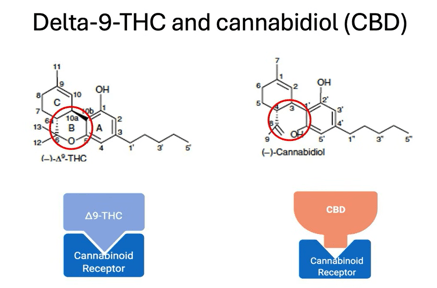
The differences in the molecular structures of THC and CBD contribute to their behaviors while interacting with cannabinoid receptors, Dr. Hillard said. She used this analogy: THC is like a flat plate, while CBD is more like a flexible barbell. THC can mimic the effects of our naturally occurring system, while CBD's structure can wiggle and change shape, so it doesn't fit the receptor the same way. It can't activate the receptor, but it can bind to other targets in the body.
What the Research Says
THC is the better-studied compound, so researchers know much more about THC than CBD. THC can produce the feeling of euphoria, reduce social anxiety, stimulate appetite, and promote sleep, while CBD can help with certain forms of childhood seizures. Dr. Hillard said the evidence is stronger for CBD creams, which are applied to the skin, than for other uses. “Rubbing it on a joint that might have arthritis or if you have some muscular back pain, people say that can be beneficial, and CBD will go right through the skin, so you don't have to take it orally."
Concerns with THC Exposure
Pregnancy and adolescence are critical periods when the brain’s endocannabinoid system is particularly important for healthy development, and THC consumption could interfere with development and potentially have lifelong consequences, Dr. Hillard cautioned. THC exposure during these times should be essentially zero because the brain is so vulnerable.
Dr. Hillard noted that today’s products are stronger than they were decades ago because of plant breeding. While higher-potency products may mean consumers need less to get a desired effect, they could also carry a risk of negative effects. Prolonged use of high doses can lead to cannabis use disorder, a condition in which a person craves cannabis, may have physical withdrawal symptoms if they stop, and finds that use interferes with daily life. While daily use can overstimulate cannabinoid receptors and make natural stress recovery less effective over time, the good news is that taking a break (and tapering rather than stopping suddenly) lets the body recover.
Dr. Hillard believes we should stop thinking of THC-containing cannabis as a medicine and think of it similarly to alcohol, a recreational substance with some risks. She noted that in the 1800s, people thought of alcohol as a medicine, but today, no one would say that. "It's really not a medicine so much as it is a molecule that can make some people feel better," she said.
To learn more about the science behind cannabis and CBD ,
watch the full Coffee Conversations with Scientists episode featuring Dr. Hillard.